← Maali Uncle website par wapas
Choosing Plants for Your Landscape: Climate-Fit Selection at Garden Scale
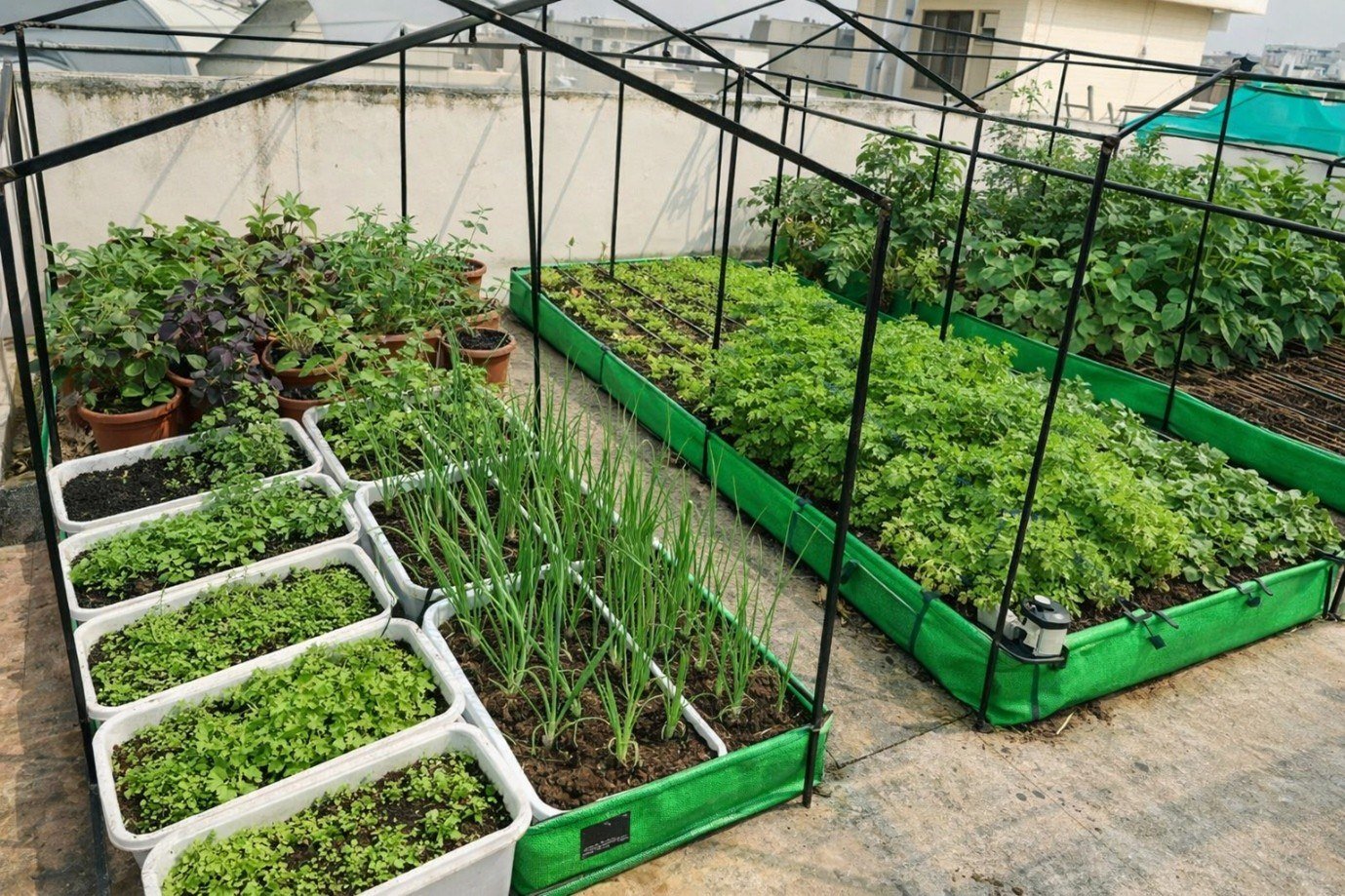
A balcony garden is a collection of pots. A landscape is a living system. The plants you put in the ground will grow for years, shade each other, compete for water, drop leaves into drains and, if you choose badly, outgrow the space and have to be cut down. Choosing plants for a landscape is therefore a different job from choosing plants for pots — it is slower, it starts with the site rather than the nursery, and the mistakes cost far more to fix.
This guide is about that job: how to choose plants for a garden, a society landscape, a terrace garden or an institutional green space in Delhi NCR. It is written at landscape scale — beds, borders, lawns and trees, not pots on a railing. If your space is a balcony, start with our balcony garden guide instead; the plant lists there are built for containers.
Think in layers, not in plants
A good landscape is built in layers, and each layer does a different job. Start by planning the layers, then choose plants for each one.
Canopy trees are the roof of the garden — they give shade, cool the air and set the character of the whole space. One well-placed tree does more than twenty shrubs. But a tree also needs room for its mature crown and roots, so this is the layer where mistakes are most expensive.
Small trees and large shrubs fill the middle height — they screen a boundary, frame a view, or mark an entrance. This is where most flowering trees belong.
Shrubs and hedges give structure at eye level: borders, screens, and the green walls that make a garden feel enclosed rather than exposed.
Groundcover and lawn cover the soil, keep dust down and tie the planting together. A lawn is a choice, not a default — it is the thirstiest and most maintenance-heavy layer in a Delhi garden, and a garden can be beautiful with groundcover, gravel and planting instead. Our hardscape vs softscape guide explains how the planted and built parts of a garden balance each other.
Climbers are the cheapest way to green a wall, a pergola or a fence — a single well-chosen climber can cover in a season what shrubs would take years to do.
Plan the layers first, then fill them. A garden chosen plant-by-plant, with no layer plan, ends up as a row of unrelated shrubs.
Start with Delhi NCR's climate, not with a catalogue
Delhi NCR asks a lot of a plant. Summer temperatures regularly cross 40°C, winter nights can drop close to single digits, the monsoon arrives in short, intense bursts, the soil in many areas is alkaline, and the water is often hard. A plant that survives all of that, year after year, is a climate-fit plant. A plant that only survives it with constant watering, feeding and protection is not — however beautiful it looked in the nursery.
Before you fall in love with any plant, ask three questions: does it tolerate extreme summer heat, does it handle a short, heavy monsoon without rotting, and does it survive a cold January night? If the honest answer to any of these is no, that plant belongs in a pot you can move, not in the ground. Our water-efficient landscaping guide explains how climate-fit choices cut water use as well as plant losses.
Read your site before you shop
Every site has its own conditions, and they matter more than any plant list. Before buying a single plant, spend a day watching your site.
Sun through the day. Which parts get morning sun, which get harsh afternoon sun, and which stay shaded? A plant that needs full sun will sulk in a shaded corner, and a shade-lover will scorch on a west-facing wall.
Where water goes. After rain, where does water collect, and where does it drain? Low spots that stay wet will rot the roots of most plants — they need water-tolerant species or drainage work first. See our monsoon-proofing guide for what to do about them.
Soil. Dig a hole and look: is the soil sandy, clayey, full of rubble, or decent garden soil? Most Delhi sites need soil improvement before planting — our soil preparation guide covers what to check and how to fix it.
Space for the mature plant. A sapling is small; the same tree in ten years may be ten metres across. Check the space above (wires, balconies, roofs) and below (drains, foundations, paving) for what the plant will become, not what it is today.
How the space is used. A children's play area, a walkway, a seating corner and a quiet border all need different plants. Thorny shrubs do not belong beside a path children use; a fragrant shrub belongs beside a seat, not hidden behind a wall.
Natives first, exotics with a reason
Native plants — the trees and shrubs of the Delhi-Aravalli region and the wider Indian subcontinent — have already passed Delhi's climate test over centuries. They usually need less water, less feeding and less protection than exotics, and they feed local birds, bees and butterflies. Make natives the backbone of your landscape: the canopy, the main shrubs and the hedges. Then add a few well-chosen non-natives where they earn their place — a flowering shrub you love, a fruit tree, a familiar favourite. Our native plants for Delhi NCR landscapes guide lists the reliable ones, layer by layer.
Be honest about origins. Many beloved Delhi garden plants — bougainvillea, gulmohar, marigold — came from elsewhere and thrive here, and there is nothing wrong with planting them. But a landscape built mostly of thirsty exotics will always need more water and care than one built mostly of natives.
Group plants by how much water they need
The single most practical planting rule at landscape scale is to group plants by water need. Thirsty plants together near the water point, dry-tolerant plants together where water is scarce, and lawn — if you have one — on its own zone. This is sometimes called hydrozoning, but the idea is simple: when plants with different thirsts share a bed, either the thirsty ones dry out or the dry ones rot.
Put the thirstiest planting closest to the house or the tap, where watering is easy, and the toughest, driest planting furthest away. Drip irrigation, where it is planned from the start, makes this far easier than hand-watering a mixed bed — and it is one of the first things to decide, before planting, not after.
Plant in the right order, and in the right season
Structure first: trees and large shrubs go in before anything else, because everything else is planted around them. Then hedges and borders, then groundcover and lawn last. Planting a lawn first and trees later means digging through your own lawn.
The monsoon is usually the kindest planting season in Delhi NCR — the rain does the watering and new roots settle fast — but only where drainage is sorted. Avoid planting in the peak of May heat, when even hardy plants struggle to establish, and avoid planting tender species just before winter. Our complete guide to landscaping in India walks through the full sequence from site survey to handover.
Common mistakes
Planting too close together. The most common landscape mistake in India. Plants look sparse on day one and crowded by year three. Space for the mature size, and fill the gaps in the first year with annuals or fast groundcover, not with more shrubs.
Lawn everywhere. A lawn is lovely and also the thirstiest, most mown, most fed part of any garden. Use it where people actually sit or play, and plant the rest.
Choosing from a nursery display. Nursery plants are fed, watered and sheltered. Ask instead: how does this species behave in a Delhi garden in May, in July rain, and in January? If the nursery cannot answer, look it up before you buy.
No maintenance plan. A landscape is not finished at handover — it needs watering, pruning, feeding and pest checks, most of all in its first year. Decide who maintains it, and how often, before planting. Our garden maintenance guide explains what a proper maintenance visit should cover.
Ignoring what is already there. An existing tree, a mature hedge or a patch of decent soil is worth more than anything you can buy. Design around what survives already, and remove only what genuinely cannot stay.
How to start
Begin with the layers and the site, not with a shopping list. Sketch the canopy, the shrubs, the groundcover and the paths; check sun, water and soil; choose natives for the backbone; group by water need; and plant the structure first, in the monsoon window. A landscape chosen this way looks good in its first year and better in its fifth — which is the real test.
If you would like help choosing plants for your own space, book an Expert Maali — we start with a site visit and a plain explanation of what your space can and cannot carry, before any design or quote. For larger projects, our Landscaping Division works on gardens, societies and institutions across Delhi NCR.
Frequently asked questions
How many trees can a small garden take? Usually one, sometimes two — and only if there is room for the mature crown. A small garden with one well-placed tree and good shrubs feels greener than one crowded with saplings that will all need removing later.
Should I plant only natives? Natives as the backbone is the practical answer. A few well-chosen non-natives — a fruit tree, a favourite flowering shrub — are fine, as long as they are chosen for your climate and grouped by water need.
When is the best time to plant a landscape in Delhi? The monsoon is usually the kindest window, because rain does the watering and roots settle fast — but only where drainage is sorted. Avoid the peak of May heat for new planting.
Can I plant a landscape in stages? Yes, and it is often wiser than planting everything at once. Plant the trees and structure first, then add shrubs and groundcover over the following seasons as the budget and the garden allow.
Is page ko Maali Uncle app mein kholo: app mein kholo