← Maali Uncle website par wapas
Native Plants for Delhi NCR Landscapes: Trees, Shrubs and Groundcover That Belong Here
Walk through the Ridge in Delhi and you will see what this region grows on its own: neem, amaltas, palash, ber, karonda — trees and shrubs that survive 45°C summers, a short and violent monsoon, and cold January nights with almost no help from anyone. Those are native plants, and they are the most reliable backbone a Delhi NCR landscape can have.
Native here means plants of the Delhi-Aravalli region and the wider Indian subcontinent that have grown here for centuries — not imports that happen to survive. This guide lists the reliable ones for gardens, housing societies and shared spaces, layer by layer. It is about outdoor, in-the-ground planting at landscape scale. The native plants browse route in our shop is a product route for buying plants; this guide is the planting knowledge behind it. For the wider question of choosing any landscape plant, read our guide to choosing plants for your landscape first.
Why natives do better here
They already know the climate. A native tree does not need to be coaxed through May or protected in January — it has survived both for generations. That means fewer losses in the first summer, which is when most landscape planting fails.
They need less water. Most Delhi natives are adapted to long dry spells between monsoons. Once established, they need far less watering than thirsty exotics — which matters in a region where water is limited and often hard. Our water-efficient landscaping guide explains how this adds up across a whole garden.
They feed local wildlife. Native flowers feed native bees and butterflies; native fruit feeds birds. A garden of natives is noticeably livelier — sunbirds on the ixora, butterflies on the karonda flowers, parakeets in the neem — than a garden of plants nothing local recognises as food.
They suit the soil. Delhi's soils are often alkaline and sometimes poor. Natives evolved in these soils and tolerate them; many exotics need constant soil correction to stay healthy.
None of this means natives are maintenance-free. They still need watering while they establish, pruning, and protection from grazing and damage. But their baseline is far more forgiving than an exotic's.
Trees: the canopy layer
Choose trees for their mature size, not their nursery size. A tree is a decades-long decision.
Neem (Azadirachta indica). The classic Delhi shade tree — fast-growing, drought-tolerant once established, and deeply useful. Needs real space: a mature neem is a large tree, so it suits gardens, societies and streets, not small plots.
Amaltas (Cassia fistula). The golden shower tree. Spectacular yellow flowers in early summer, moderate size, and very heat-tolerant. One of the best flowering trees for a Delhi garden that has room for a medium tree.
Palash (Butea monosperma). The flame of the forest — vivid orange-red flowers in spring, tough, drought-hardy, and a true native of this region. Slow to establish but very long-lived.
Kachnar (Bauhinia variegata). Pink-purple orchid-like flowers in spring, moderate size, and tolerant of Delhi's heat and poor soils. Good as a small garden tree or a society planting.
Jamun (Syzygium cumini). Dense shade, edible fruit that birds love, and very tolerant of Delhi conditions. Needs space — it becomes a large tree — and drops fruit in season, so keep it away from paths and parked cars.
Arjun (Terminalia arjuna). A strong, long-lived shade tree that handles heat and variable water well. Best for large gardens, institutions and avenues rather than small plots.
Peepal and banyan. Magnificent, sacred, and far too large for most gardens. Plant them only where there is genuine space — a large society green, an institution, a farmhouse — and never near buildings, drains or boundary walls, because their roots will find every weakness.
A note on a much-loved tree: gulmohar is not a native — it came from Madagascar — but it thrives in Delhi and is planted everywhere. It is a fine tree if you have the space; just do not mistake it for a native when you are counting on native resilience.
Shrubs and hedges
Karonda (Carissa carandas). A tough native hedge shrub with white flowers, edible berries and thorns that make it a genuinely useful boundary plant. Handles heat, drought and poor soil.
Chandni (Tabernaemontana divaricata). White, fragrant flowers through much of the year, neat evergreen growth, and very tolerant of Delhi conditions. Good as a shrub or a loose hedge near seating areas, where the fragrance is appreciated.
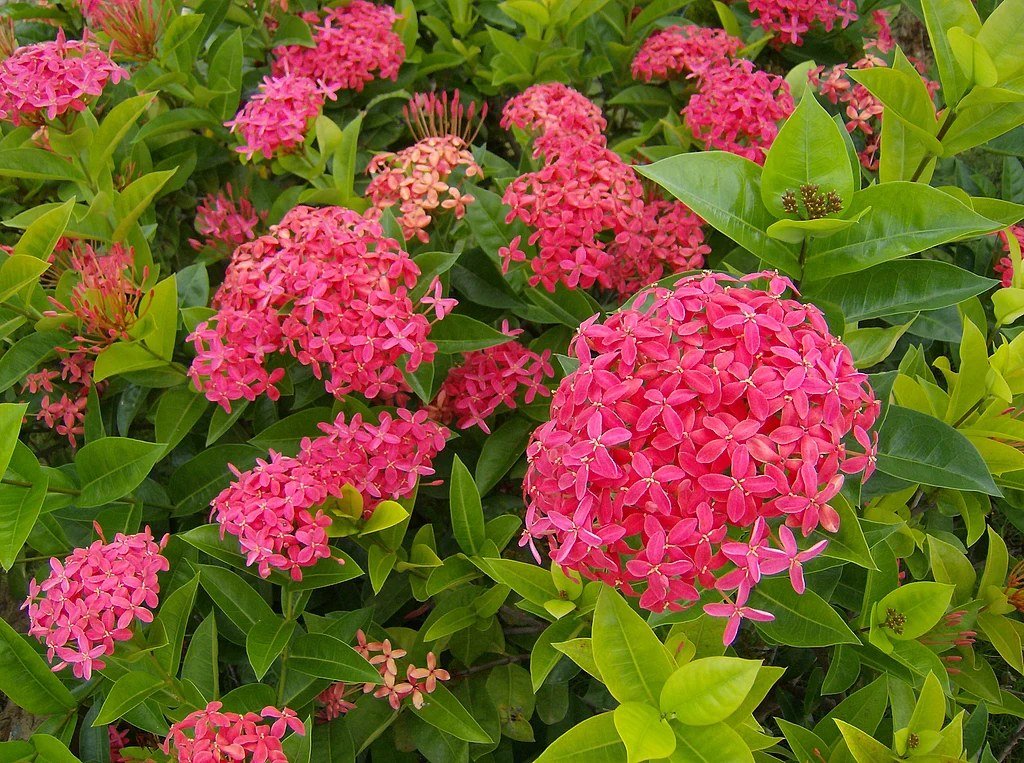
Ixora (Ixora coccinea). Dense clusters of red, pink or orange flowers, evergreen, and one of the most reliable flowering shrubs for Delhi gardens. Needs regular watering to flower well, so group it with other moderately thirsty plants.
Ber (Ziziphus mauritiana). The Indian jujube — thorny, extremely drought-hardy, and a source of fruit and birdlife. Better as a boundary or a wilder corner than beside a path, because of the thorns.
Madhumalti (Combretum indicum, Rangoon creeper). A native climber with fragrant flowers that change colour from white to pink to red. Excellent for pergolas, fences and walls — one of the best native climbers for a Delhi garden.
Adusa / Vasaka (Justicia adhatoda). A hardy native shrub with white flowers, traditionally known in Ayurvedic practice, and very tolerant of neglect. Useful as a filler shrub in a mixed native border. Traditional uses are mentioned here as tradition, not as medical advice.
Bougainvillea deserves an honest note too: it is not native — it came from South America — but it is so well adapted to Delhi that it flowers almost all year with very little water. It is a legitimate choice for walls and fences; just do not count it as a native when planning for wildlife.
Groundcover, grasses and the spaces between
Doob grass (Cynodon dactylon). The native lawn grass of India — heat-tolerant, drought-tolerant once established, and able to recover from wear. It goes brownish in peak winter and greens up again with warmth; that is normal, not a failure.
For non-lawn groundcover, native options are fewer in the nursery trade than exotics, and that is a genuine gap. A practical approach is to use natives for the structure — trees, shrubs and hedges — and to fill groundcover gaps with tough, low-water plants that are known to behave in Delhi, keeping lawn only where people actually sit or play. Mulch and gravel, planned as part of the design rather than as an afterthought, cover the rest honestly. Our hardscape vs softscape guide explains how planted and unplanted surfaces should balance.
Mixing natives with old favourites
Not every plant in a Delhi garden needs to be native. Marigold (from Mexico, originally) is the flower of every Indian festival; hibiscus is a garden classic across the country. A sensible rule is natives as the backbone — the canopy, the hedges, the main shrubs — and familiar favourites as the accents, grouped by water need so the thirsty ones are watered together and the tough ones are left alone. That way the garden reads as a Delhi garden, survives Delhi summers, and still has the flowers people love.
What to avoid is the opposite: a landscape built entirely of thirsty exotics that need daily watering, feeding and protection to survive May. That is not a garden; it is an intensive-care unit with leaves.
Buying and planting natives
Ask for botanical names. Common names vary by region and nursery. A botanical name is the only reliable way to be sure you are buying the species you want — especially for trees, where a wrong species means a wrong mature size.
Check the nursery. Good nurseries in Delhi NCR do stock natives, but they are often at the back, behind the flowering exotics. Ask directly for the species on your list, and check that the plant is healthy — firm in its pot, with fresh growth, not root-bound or wilting.
Plant in the monsoon window where possible. Rain does the watering and new roots settle fast — but only where drainage is sorted. Read our monsoon-proofing guide before planting in low or waterlogged spots.
Water to establish, then ease off. Even the toughest native needs regular watering for its first year or two while roots establish. The water saving comes after establishment, not before — a tree planted and abandoned in May will usually die, native or not.
Prepare the soil. Most Delhi sites need soil improvement before planting — loosened, compost-enriched, and free of rubble. Our soil preparation guide covers what to check.
Start with the backbone
If you remember one thing from this guide, let it be this: choose the trees first, from the native list, sized for the space you actually have. Everything else — shrubs, hedges, climbers, lawn — is easier to change later. A tree is a decision for decades, and a native tree is the decision most likely to still be standing, shading your garden and feeding birds, twenty summers from now.
If you would like help planning native planting for your garden, society or institution, book an Expert Maali — we start with a site visit and a plain explanation of what your space can and cannot carry. For larger projects, our Landscaping Division works across Delhi NCR.
Frequently asked questions
Are native plants really lower maintenance? Once established, usually yes — they need less water and less protection than thirsty exotics. But they still need watering in their first year or two, pruning, and protection from damage. Lower maintenance is not no maintenance.
Can I grow natives on a terrace or balcony? Some shrubs — ixora, chandni, karonda — can grow in large containers, but trees need the ground. For containers, read our balcony garden guide and our rooftop garden considerations before planting anything large above ground level.
Where do I buy native plants in Delhi NCR? Ask nurseries directly for species by botanical name — many stock natives even if they are not on display. Check the plant is healthy and firm in its pot before buying, and prefer a nursery that can tell you where the plant was grown.
Will a native garden look less colourful? No — amaltas in summer, palash in spring, ixora almost all year and madhumalti on a wall give a native garden plenty of colour. The colour is seasonal rather than constant, which is how a real garden behaves.
Is page ko Maali Uncle app mein kholo: app mein kholo